The Duskbloods Hands-On Preview: FromSoftware’s Surprising Switch 2 PvPvE Game
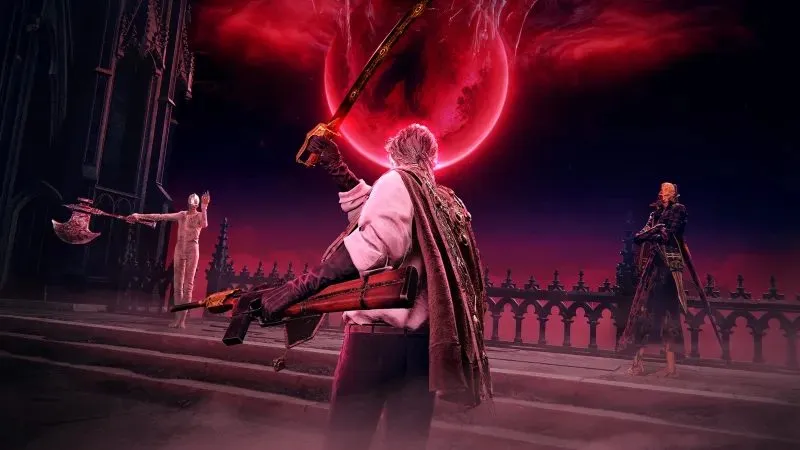
FromSoftware’s The Duskbloods looks far less like a straightforward PvPvE pitch than its reveal suggested. After several hours with the Switch 2 exclusive in Tokyo, the strongest impression is a competitive game built around exploration, mobility, character builds, and opportunistic fights, rather than constant player hunting. It still asks players to outlast rivals, but much of that struggle happens through scavenging resources, clearing monsters, completing side objectives, and choosing when to commit to a duel.
The game has reportedly been in development since 2021, during the period when FromSoftware was still working on Elden Ring. Director Hidetaka Miyazaki said the project was not created to follow Elden Ring’s success or to signal a broader shift away from the studio’s single-player work. He also said The Duskbloods began on the original Switch before moving to Switch 2, a change that appears to have spared the team from technical compromises.
The setup centers on the Bloodsworn, vampiric warriors competing in the Twilight of Humanity for a reward called First Blood. More than 10 playable Bloodsworn are planned for launch, with six available in the current build and for the closed network test starting August 21. Each fighter carries both close-range and long-range tools, along with unique abilities, but the fundamentals still feel rooted in FromSoftware’s action combat.
Traversal is one of the clearest departures from that formula. Bloodsworn can chain up to four jumps before landing, sprint without consuming stamina, and drop from extreme heights without taking fall damage. That freedom changes how matches flow, because reaching rooftops, cutting across the map, and diving onto other players become part of the standard rhythm rather than special-case movement tech.
Another standout mechanic is blood draining. A well-timed howl works like a parry, staggering enemies and opening them up for a neck bite. Against regular foes, that bite restores some health and can convert smaller enemies into temporary allies. Against other players, it interrupts attacks and deals meaningful damage. That system creates moments where a player can move into a fight with a crowd of AI followers, adding pressure without relying only on raw weapon strength.
Kin, the game’s summonable companions, add another layer. They are called in through portals and stay with the player for the rest of a match, leveling up as they defeat enemies. Some offer direct combat support, while others lean toward buffs or survivability. One of the more memorable examples is Baritone, a towering singer whose performance boosts stats while he throws enemies around with wrestling attacks. Swapping to a new Kin is possible, but it resets that companion to level 1, which turns the choice into a meaningful risk.
Matches, called Dusk Battles, support eight players and unfold across four phases. The main objective is to build Virtue, which acts as the score that determines who advances. Virtue comes from multiple sources: defeating players, killing enemies, beating bosses, discovering hidden rewards, and finishing smaller tasks tied to different Virtue types. Flame Virtue, for example, is found on hidden corpses and can only be claimed once, rewarding exploration and route knowledge as much as combat skill.
Phase I has no eliminations, so it works as a preparation round for leveling, finding items, and unlocking more abilities. Phases II and III begin cutting low-ranked players and introduce Ritual Sites, contested zones that reward either direct PvP wins or the defense of captured objectives. By the time the top three players reach Phase IV, the game shifts into a much tighter final arena where each player has two lives before elimination.
Character-specific Sigils broaden the strategy even further. These optional missions can ask a player to hunt a marked rival, form an alliance, pursue a Heretic target, or even propose marriage to another competitor. Private lobbies are also supported, according to Miyazaki, alongside standard matchmaking.
The current map, Lowarno City, leans hard into vertical design. Its cathedral spaces, caves, underground ruins, poison swamp, and towering bell structure make it feel built for ambushes and sudden escapes. Random global Events can reshape that space mid-match, including firebombing from a zeppelin, teleporting lightning, or a falling star that grants bonus Virtue to whoever holds its shard at the end of a phase.
The Duskbloods does not read like a multiplayer reskin of Elden Ring. It feels more like FromSoftware pulling invasion tension, summon dynamics, and build expression into a dedicated competitive structure, then adding enough movement and side systems to make every match less predictable than a standard last-player-standing format.