The Killing Stone Review: Elizabethan Deckbuilder with Devilish Charm
The Killing Stone is a razor-tongued roguelite deckbuilder that swaps arenas for annals, turning every run into a duel of wits over infernal fine print. Equal parts card tactics and satanic contract law, it pairs a theatrical Elizabethan voice with fiendishly clever mechanics, especially its two-line battlefield and pack-based deckbuilding. It’s not the widest toolbox in the genre, but its atmosphere, puzzle-like encounters, and devil-may-care storytelling make it a standout for players who crave definition and drama with their draws.
If you’ve ever wanted a deckbuilder where “reading the clause” is as thrilling as top-decking lethal, The Killing Stone is your ticket to the gallows. You step into a 17th-century occult drama, hunting for loopholes across a tangle of demonic pacts while trying to rescue a family that’s bartered away more than their Sunday shoes. The hook isn’t a wizardly duel in a void, it’s a ritual debate over contracts that sprawl like scrolls across your runs. Each clause is an encounter, each amendment a gamble, and every victory feels like you out-argued a devil rather than simply out-damaged them.
What sets it apart
- Period flavor you can actually flip on or off. There’s a “modern” script for a cleaner read, and an Elizabethan option that goes full theater-kid, winking through wordplay and righteous invective. It’s playful, verbose, and surprisingly readable once you tune into the cadence.
- Contract-as-map. Campaigns branch across a parchment of clauses, each node offering its own stakes: lean upgrades, elite challenges, risky negotiations for boons and banishments. It’s familiar roguelite structure, but the legal framing adds a satisfying sense of cat-and-mouse.
- Packs over single cards. Instead of fine-tuning one card at a time, you win, trade, and upgrade entire packs, mini-collections with their own themes, synergies, and sometimes unavoidable curses. It’s a bold constraint that makes every swap feel consequential.
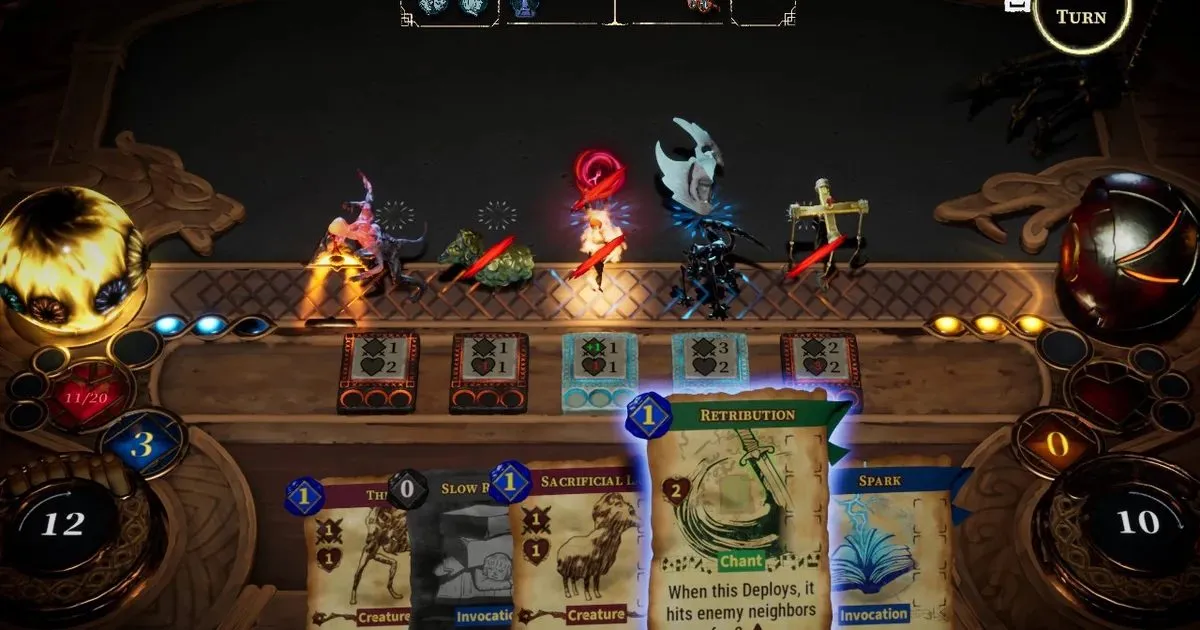
The battlefield: two lines, one brain Combat marries clarity with depth by using a six-slot frontline for each side and a separate reserve. Minions you play to the frontline clash toward the opposing “base,” while the reserve line holds reinforcements, attachments, and tricky tools that slide in when a frontline unit falls. It’s a careful dance of spacing, tempo, and delayed gratification, stack a supporting piece now so it tumbles into a decisive slot later, or bait the enemy to open a lane this turn and punish the gap the next.
This dual-row tension is where The Killing Stone sings. Reserve pieces often can’t attack immediately, but they distort the game state: buffers that punish overextension, contraptions that rewrite positioning, or safeguards that refuse to be sniped cleanly. You get a rewarding push-pull between preparing inevitabilities and improvising around what the contract coughs up.
Devilish details
- Your “base” at either edge of the field is your lifeline. Let it get chewed up and the run ends, unless you spend a special currency to resume mid-ritual. That decision is gutting in the best way, especially on a promising build where one misplay spiraled.
- Curses aren’t just bad beats. They hitch rides in powerful packs, can’t be traded away, and occasionally demand to be played. Accepting a cursed bundle is like shaking hands with a demon: thrilling value now, gnarly obligations later.
- You don’t buy away your mistakes. Because you swap packs rather than pluck singles, you live with your choices longer. The trade meta is less “perfect the 30” and more “steer the fleet.” It’s a very different rhythm than the usual surgical deck pruning.
Narrative fire and brimstone Even if you ignore the period option, the writing leans into theatrical villainy and late-night cackles. Demons pout, sneer, and posture whenever you catch them in a contradiction. The supporting cast, each Svangård soul you’re trying to pry free, filters into your kit as run-specific boons and quirks. One early case leans into sleepwalking units; another might wrap your toolkit in stubborn barricades or swarming pests. These mechanical signatures do double duty as character work, keeping each arc distinct.
Voice performances add weight. The one-eyed tempter steals scenes, while spectral mentorship offers gravitas and bite without clogging up play. It feels curated rather than endlessly generated, and that intent shows in how encounters build toward specific payoffs.
How it plays compared to the genre If Slay the Spire is a chemistry set and Monster Train a conveyor-belt battleground, The Killing Stone is a courtroom drama with daggers under the table. It’s less about discovering wild infinite loops and more about piloting a clear, flavorful plan through bespoke challenges. The maps aren’t endlessly procedural; they often feel handcrafted, nudging you to “solve” the run around a theme rather than only ride high-roll streaks.
That narrower canvas cuts both ways:
- The good: strong identity, fewer dud paths, and lots of moments where clever positioning or pack juggling wins the day.
- The trade-off: fewer off-the-wall combos and a slightly smaller ceiling for absurd synergies. If you’re chasing the purest sandbox of possibility, you might feel the rails. If you like targeted friction and narrative propulsion, this is catnip.
Learning curve and cadence
- Early runs teach by spectacle: you’ll grab a shiny pack, swallow a curse you swear you can handle, then watch your formation unravel three clauses later. That’s part of the drama.
- Midgame mastery lives in reading the battlefield two turns ahead. The reserve line isn’t a bench, it’s your insurance policy, your trap card, your tempo plan.
- Late-game consistency hinges on pack discipline. Know which bundles define your lane and resist the urge to dilute your through-line with off-theme candy.
Presentation and polish The parchment UI, the ink-blot transitions, the clack of seals breaking, everything sells the conceit that you’re untangling wicked paperwork at a witching-hour desk. The tone walks a tightrope between sardonic and sinister, and while the period script can occasionally go full word-salad, the performance lifts it. The modern option is serviceable if you prefer briskness, but the flavor truly pops when the language leans archaic.
Wishlist tweaks
- A touch more late-run variability would help long-term replay. Even one or two wild-card packs per chapter could open new routes without breaking theme.
- More granular pack management, for example, rare tokens that let you un-staple a single cursed hitchhiker, could deepen decision-making without gutting the core identity.
The verdict The Killing Stone is a smart, stylish spin on the deckbuilder that thrives on structure: lines to hold, clauses to parse, and packs to shepherd. It’s devilishly charming in its presentation and sharp in its tactics, trading raw combo breadth for bespoke encounters and theatrical confidence. If you want a deckbuilder that argues as hard as it attacks, ink your name. The clause you’ll like most? The one that says you can’t stop at just one run.